

This is not just a golf tournament. It is a cultural event that happens to crown a PGA Tour winner.
The Waste Management Phoenix Open lives in a category of its own. Once a year, professional golf steps out of its comfort zone and into something louder, rowdier, and far more unpredictable than anything else on the schedule.
Players know what they are signing up for. Fans know exactly what is expected of them. And for one week in the desert, golf trades polite applause for full-throated noise.
Love it or hate it, nothing else on Tour looks or feels like this.

The Phoenix Open dates back to 1932, long before it became golf’s loudest week. For much of its history, it was a traditional PGA Tour stop, respected but rarely talked about outside golf circles.
The turning point came in 2010, when Waste Management took over as title sponsor.
Instead of trying to suppress the crowd, the tournament embraced it. Stadium seating expanded. Music became part of the atmosphere. Fan behavior shifted from tolerated to encouraged. At the same time, Waste Management leaned hard into sustainability.
Since 2013, the tournament has operated as a 100 percent Zero Waste event, diverting all waste away from landfills through recycling, composting, and reuse programs. It remains the first PGA Tour event to achieve that standard and has maintained it every year since.
The result is a strange and successful balance. On the surface, the event feels chaotic. Behind the scenes, it is one of the most carefully run tournaments in professional sports.
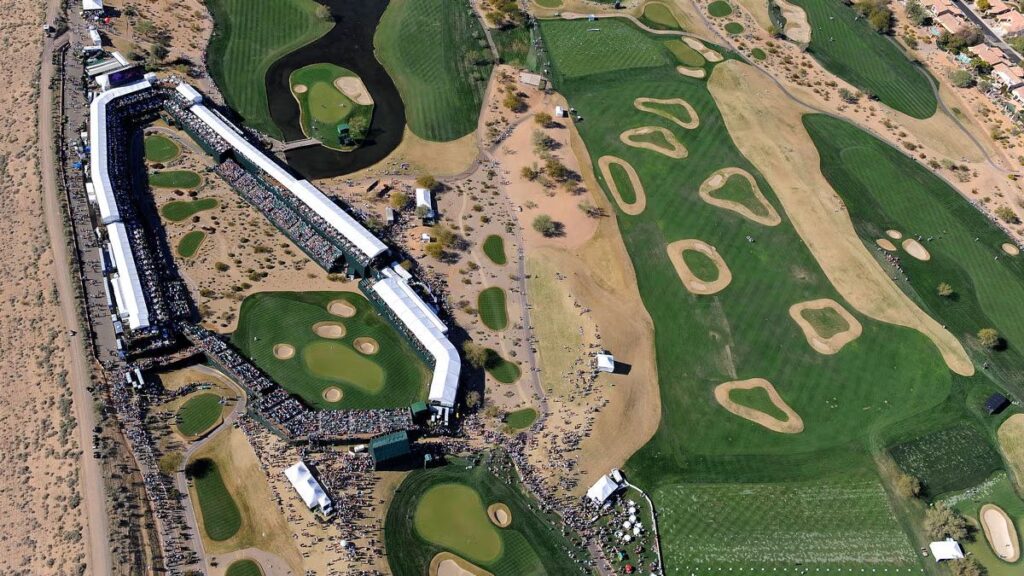
The tournament is played at TPC Scottsdale Stadium Course, a desert layout that quietly exposes flaws.
At first glance, it does not look overly intimidating. In reality, it demands precision.
Key challenges include:
This is not a course that allows players to relax. Which makes its most famous hole even more unsettling.
TPC Scottsdale introduces a reality that every desert golfer learns sooner or later. The desert does not forgive.
Firm fairways, unpredictable bounce, and native desert areas mean golf balls do not slowly wander into playable rough. Even well-struck shots can take a sharp kick and disappear into rock, scrub, or cactus. When that happens, there is no recovery. The penalty is immediate and absolute.
This is what many players refer to as the Desert Tax.
It is not about bad swings. It is about environment. Miss a fairway by a few yards and the cost is often a lost ball and a dropped stroke. Over the course of a round, or a tournament, that tax adds up quickly.
For PGA Tour players, the risk is managed through precision and discipline. For everyday golfers, it becomes a practical decision as much as a strategic one. Desert golf demands respect not just for shot-making, but for the reality that the course will eventually take something from you.
Understanding that cost is essential to understanding how this tournament is played, and why equipment choices matter more here than at many other stops on Tour.
The par-3 16th hole is the reason the Phoenix Open has global recognition.
Completely enclosed by stadium seating, it is the loudest hole in professional golf. Players are not shielded from the crowd. They are placed directly in front of it.
Great shots are celebrated immediately. Misses are booed just as quickly. The reaction is instant and unavoidable.
This is not a gimmick. Veteran players openly admit the tee shot feels uncomfortable. Hands tighten. Heart rates spike. It is the closest thing golf has to playing in a hostile road arena.
The hole became legendary in 1997, when Tiger Woods made an ace that sent beer flying and permanently altered the tournament’s identity.
More recently, the hole reminded everyone just how wild things can get during the 2022 tournament, when a hole in one triggered one of the most chaotic beer showers the sport has ever seen. Cups rained down, play stopped, and the moment went viral far beyond golf media.
There is nothing else like it.

Winning in Phoenix has less to do with tuning out the crowd and more to do with accepting it.

Some notable champions include:
The common trait is emotional control. Players who fight the environment rarely last. Players who accept it give themselves a chance.
Every year, the tournament produces scenes that do not happen anywhere else on Tour.
Common sights include:
It is the only PGA Tour event where crowd participation feels baked into the competition.
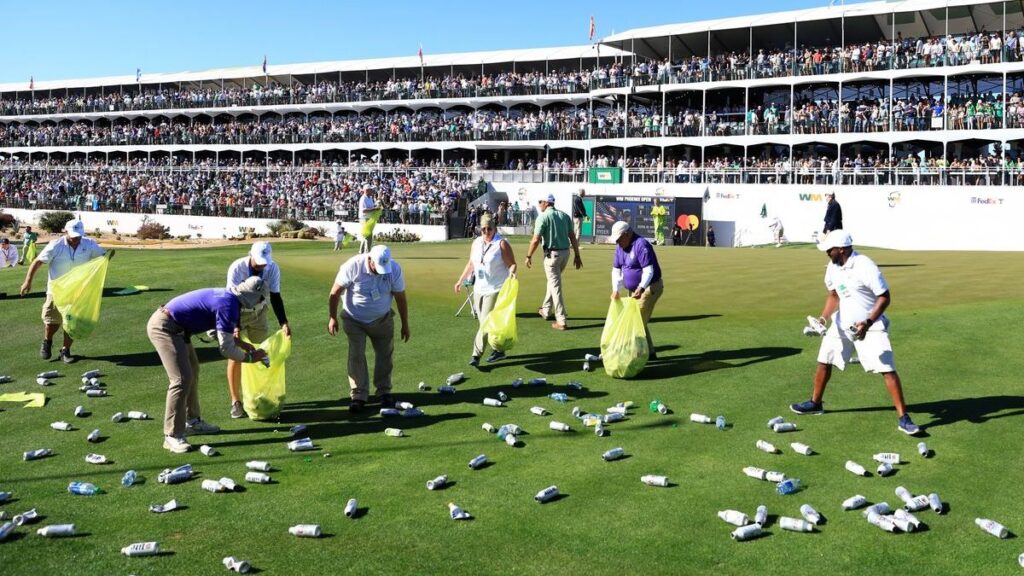
The party reputation is real, but it is incomplete.
The Phoenix Open has been a Zero Waste event since 2013, setting a standard other tournaments still struggle to match. Every cup, wrapper, and piece of waste is tracked, sorted, and diverted.
It is proof that scale, entertainment, and responsibility do not have to be mutually exclusive.
Once you understand the Desert Tax, the conversation around golf balls at TPC Scottsdale becomes much more straightforward.
The course demands consistency more than creativity. Firm fairways, fast greens, and reduced air density reward balls that fly predictably, spin reliably, and hold their line in the wind. That is why tour-level golf balls dominate this tournament.
At the professional level, players rely on golf balls designed to deliver:
These performance traits are why models with Pro V1 and Pro V1x-style profiles are used almost universally inside the ropes.
For amateur players, the performance needs are similar, but the economics are not.
Independent testing consistently shows that high-quality used tour balls perform nearly identically to brand-new balls. Carry distance differences are minimal, spin rates remain consistent, and ball speed is effectively unchanged. What actually impacts performance is surface damage, not whether a ball is new or pre-played.
At a course like TPC Scottsdale, where lost balls are an expected part of the round rather than a rare mistake, playing a clean, high-grade used tour ball offers a clear advantage. You get the performance the course demands without turning every bad bounce into a costly penalty.
That balance between performance and practicality is why premium used golf balls are a smart fit for desert golf.

The Phoenix Open works because it respects the competition while refusing to be boring.
It brings new fans into golf.
It tests players mentally as much as physically.
It proves sustainability and spectacle can coexist.
Once a year, the PGA Tour lets the game get loud.
And for one week, golf is better for it.